5 ABA Techniques for Managing Challenging Behaviors in Children
Applied Behavior Analysis (ABA) is one of the most widely researched and scientifically validated approaches for helping children navigate challenging behaviors. Whether a child is struggling with communication, emotional regulation, or daily routines, ABA techniques for children offer a structured, compassionate framework for building meaningful skills.
If you're a parent, caregiver, or educator searching for effective, evidence-based strategies, understanding how ABA methods for children work can be a genuine turning point.
In this post, we'll walk through five proven ABA techniques that therapists and caregivers use to manage challenging behaviors in children and explain why they work.
What Is ABA Therapy?
Before diving into important ABA techniques for children, it helps to understand the foundation of this therapeutic approach to managing challenging behaviors.
Applied Behavior Analysis offers a therapeutic approach rooted in the science of learning and behavior. It has grown into the “gold standard” for supporting children with autism and other developmental or behavioral challenges.
ABA is based on a simple but powerful idea: behavior is shaped by its consequences. When a certain behavior is given a reactive response, it’s more likely to occur again. On the other hand, when that behavior is followed by either no response or a redirected response, it decreases over time.
It’s important to note that ABA therapy is highly individualized. Each child requires their own unique needs, strengths, and challenges. When seeking ABA therapy, a board-certified behavior analyst (BCBA) designs a treatment plan tailored to the individual. This treatment plan includes management techniques across numerous locations where challenging behavior may occur, including:
Parents and caregivers are active participants in this plan, as well.
Keep in mind that modern ABA methods are not about forcing compliance; they are about understanding why a child behaves a certain way. By doing so, ABA therapists can provide better tools to communicate and learn, allowing the child to thrive in all environments.
5 ABA Therapy Techniques for Children
Managing child behavior with ABA isn't a one-size-fits-all process, but there are core methods that skilled therapists return to again and again. Here are five of the most effective ABA methods for children dealing with challenging behaviors.
1. Positive Reinforcement
Positive reinforcement is one of the most fundamental—and frequently used—ABA techniques for children. It involves following a desired behavior with something the child finds rewarding, whether that's verbal praise, a favorite snack, extra screen time, a sticker, or access to a preferred toy. The goal is simple: make the behavior worth repeating.
For example, if a child uses words to ask for help instead of melting down, immediately acknowledging that with enthusiastic praise ("Great job asking! I'm so proud of you!") increases the likelihood they'll choose words again next time.
The key to making positive reinforcement work is identifying what's truly motivating to that specific child. What one child finds rewarding may be completely uninteresting to another. A skilled therapist will conduct preference assessments to determine what reinforcers are most effective, then strategically use them to strengthen desirable behaviors over time.
Positive reinforcement is also one of the most natural-feeling ABA methods for children because it focuses entirely on what's going right, and not on punishment or correction.
2. Differential Reinforcement
Differential reinforcement takes positive reinforcement a step further. Instead of reinforcing all behaviors equally, this technique reinforces specific desired behaviors while withholding reinforcement for undesired ones. It's one of the most powerful tools in managing child behavior with ABA because it teaches children what to do, not just what to stop doing.
There are several variations:
Differential Reinforcement of Alternative Behavior: Reinforcing a replacement behavior that serves the same purpose as the challenging behavior. For example, reinforcing a child for raising their hand instead of shouting out in class.
Differential Reinforcement of Other Behavior: Reinforcing the child during any period in which the challenging behavior does not occur.
Differential Reinforcement of Lower Rates: Used when a behavior isn't harmful but happens too frequently, reinforcing the child when they engage in the behavior less often.
Consider a child who throws tantrums when they're upset or frustrated. With differential reinforcement, the therapist would reinforce the child each time they use an appropriate coping strategy—like taking a deep breath or asking for a break—while consistently not rewarding the tantrum itself. Over time, the appropriate behavior increases because it's the one that works.
3. Antecedent Intervention
While many behavior strategies focus on what happens after a behavior, antecedent interventions focus on what happens before it. By modifying the environment or circumstances ahead of time, antecedent strategies can prevent challenging behaviors from occurring in the first place.
This is one of the most proactive ABA methods for children, especially those with autism or sensory processing differences who may struggle with unpredictability or transition.
Common antecedent strategies include:
Visual schedules: Providing a picture-based or written schedule so children know what to expect throughout the day.
Priming: Giving a child a heads-up about an upcoming transition or change in routine.
Environmental modifications: Reducing sensory overload in a classroom or therapy space.
Offering choices: Giving a child two acceptable options so they feel a sense of control.
Simplifying tasks: Breaking down a complex instruction into smaller, manageable steps.
For example, a child who frequently becomes dysregulated during transitions from recess to classroom work might benefit from a five-minute warning plus a visual timer. By changing the antecedent—the warning system—the behavior often improves without any direct consequence-based intervention at all.
4. Function-Based Intervention
One of the most sophisticated and important ABA techniques for children is the function-based approach. Rather than simply trying to eliminate a challenging behavior, function-based intervention asks: Why is this behavior happening?
Every behavior serves a function. Most fall into one of four categories:
Attention: The child wants interaction or acknowledgment from others.
Escape/Avoidance: The child wants to get out of a task, situation, or demand.
Access to tangibles: The child wants a specific item or activity.
Sensory/automatic reinforcement: The behavior feels good or provides internal stimulation.
To identify the function, a BCBA conducts a Functional Behavior Assessment (FBA), which includes observation, data collection, and interviews with caregivers and teachers. Once the function is identified, the therapist designs an intervention that addresses that specific motivation.
For example, if a child engages in self-injurious behavior as a way to escape difficult tasks, punishing or ignoring the behavior without addressing the underlying need won't work in the long run. Instead, the therapist would teach the child a functional communication alternative, like handing over a "break" card or saying "I need help.” This accomplishes the same goal in an appropriate way.
Function-based intervention is one of the most respectful and effective approaches to managing child behavior with ABA because it treats the child as a communicator, not a problem to be fixed.
5. Naturalistic Teaching
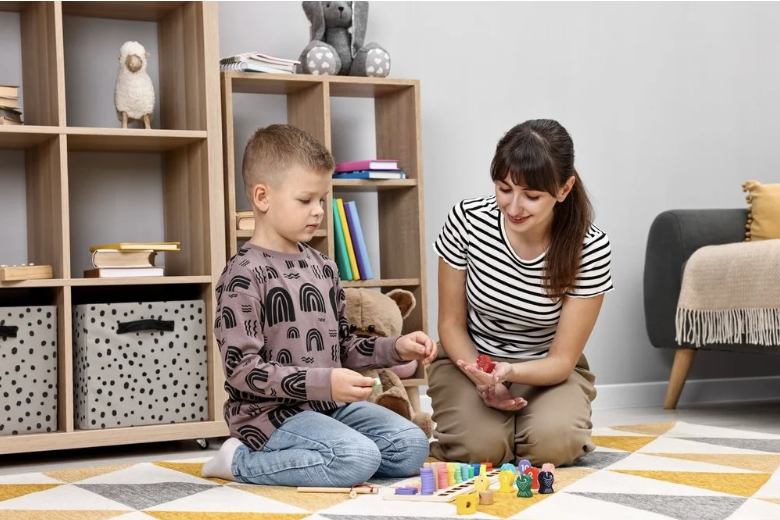
Naturalistic teaching is an ABA method that meets children where they are—in their natural environment, following their lead, and using their own interests as the vehicle for learning. Rather than drilling skills at a table in a clinical setting, naturalistic teaching embeds learning into everyday play and routines.
This approach is especially effective for younger children or those who respond poorly to structured, adult-directed tasks. It's also one of the most enjoyable ABA techniques for children because it rarely feels like "work."
Examples of naturalistic teaching include:
Using a child's love of building blocks to teach counting, colors, and turn-taking.
Incorporating a child's favorite TV characters into social skills practice.
Teaching requesting skills during a snack routine rather than a formal drill.
Using bath time as an opportunity to practice following two-step directions.
The therapist or caregiver follows the child's motivation, creates opportunities to practice target skills, and reinforces correct responses naturally within the context of the activity. Because the child is engaged and intrinsically motivated, learning tends to generalize more easily to real-world situations.

Every Child Is Different—and That's the Point
It's worth emphasizing that no two children are the same, and effective ABA therapy should never look identical from one child to the next.
These five ABA techniques for children are powerful tools, but their success depends entirely on how thoughtfully they're applied. A qualified BCBA will conduct thorough assessments, collaborate closely with families, and continuously adjust the treatment plan based on data and the child's progress.
The goal of managing child behavior with ABA isn't to make children more compliant; it's to give them the skills, communication tools, and confidence to navigate the world more successfully.
Ready to Get Started? Regal Behavior Solutions Offers ABA Therapy in St. Louis!
If you're looking for compassionate, evidence-based ABA therapy for your child, Regal Behavior Solutions is here for you. Our team of experienced, board-certified behavior analysts is dedicated to helping children and families achieve meaningful progress through individualized, family-centered care.
Whether your child is just beginning their ABA journey or needs a new approach to persistent challenges, we'll work alongside you every step of the way.
Contact Regal Behavior Solutions today to schedule a consultation and take the first step toward lasting, positive change for your child.
